
The Anti-Displacement Policy Map identifies selected anti-displacement policies were in place in California jurisdictions as of January 1, 2026 (see chart below for list and here for complete table). The table below describes the methodology for each policy and provides links to legal databases, where available. Anti-displacement policies such as density bonuses, accessory dwelling units, and just cause eviction are in place at the state level and thus are not included for individual cities on the map.
Policies, programs, and ordinances change over time. This map was current as of January 1, 2026; the Urban Displacement Project has no plans to update this map. To determine if a particular policy has changed, please use this update checker (in Python).
The map was compiled through hundreds of hours of web research by a UC Berkeley student team. Every jurisdiction in California (contacted via a list provided by the California Department of Housing and Community Development) had the opportunity to comment and correct the map early in 2026.
An extraordinary team powered this effort, including staff members Madeleine Parker, Julia Greenberg, and Blaire Frett (UC Berkeley) and Yihoi Jung and An Pham (University of Toronto); and UC Berkeley students Raelin Angulo, Mckenzie Diep, Abby Griffith, Alisa Karesh, Kati Khov, Chenghao Li, Allen Lopez, Lucas Santana, Nicole Shkurovich, Ariana Siordia, Bo Wang, Mila Yglesias, and Zack Yu.
We are grateful to the California Air Resources Board for funding this work under Agreement 24IT-STC005.
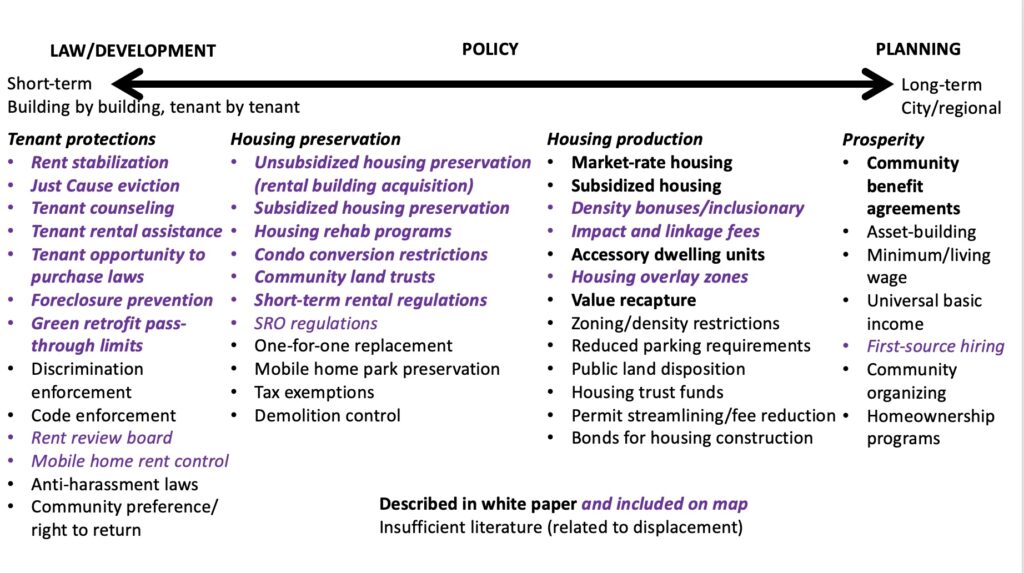
Policy | Definition |
Just Cause Eviction | A landlord must have a legitimate, legally recognized reason (“just cause”) to evict a tenant. In some policies this only applies especially once the tenant has lived in the unit for a certain amount of time (often 12 months) California state law (AB 1482/ Code Section 1946.2) now requires that landlords must have a just cause to evict tenants who have lived in the same unit for 12 months or longer. We therefore are no longer tracking specific jurisdiction-level just cause protections. |
Rent Stabilization or Rent Control | Local laws that limit how much a landlord can increase the rent each year for certain types of residential rental units. California state law (AB 1482) implements rent stabilization for certain units after a tenant has lived there for 12 months, limiting rent increases to a maximum of 5% + change in cost of living (CPI) each year, or 10%, whichever is lower. Certain properties are exempted, including units in buildings constructed in the last 15 years and single-family owner-occupied residences. Jurisdictions with rent stabilization or rent control protections that are broader (applying to more units) or stronger (restricting rents to lower levels) than state law are marked as Yes on the policy map. |
Rent Review Board | A local government body (usually a commission, panel, or board) that is responsible for resolving disputes between landlords and tenants, including disputes regarding rent increases. |
Mobile Home Rent Control | Refers to local laws that limit rent increases for the rent of the land that a mobilehome owner rents in a mobilehome park. |
SRO Preservation | Ordinance protecting existing SRO housing (small, affordable, single-room units, often with shared kitchens or bathrooms) from being demolished, converted, or eliminated. Ordinances often define an SRO as a residential building with small individual units (sometimes under a specific square footage, such as 220 sq ft) and shared facilities. A limited number of jurisdictions in California provide specific protections for the preservation of SRO units. The policy map also includes references to code allowing for the provision of SRO units. |
Condominium Conversion Restrictions | Condominium conversion restrictions involve limitations on the conversion of rental units to condominiums. These restrictions range from prohibitions on the conversion of rental units to condominiums to tenant protections such as relocation assistance, lifetime leases, and restrictions on rent increases (California Department of Housing and Community Development 5) |
Foreclosure or Homeownership Assistance | Local protections or support programs that help tenants or homeowners avoid foreclosure. For the policy map, this category focuses on funding for current homeowners, as opposed to including funding for first-time/low-income homebuyers to purchase a home. Emergency foreclosure programs related to the Covid-19 pandemic that were time-limited were excluded. |
Inclusionary Zoning and Affordable Housing Linkage Fees | Inclusionary zoning refers to zoning that requires a certain percent or number of units be rented to lower-income households at affordable rates, which may involve public funding or incentives. Required affordable units are often provided on-site, but unfunded inclusionary zoning may include an “in-lieu” fee option, where fees are contributed to the development of affordable housing at another location. Inclusionary zoning is considered a ‘yes’ even if it is limited to only certain geographies or building types. Linkage fees refer to fees on new development that go towards the development of affordable housing units. They do not have an on-site option. Due to the similarity of these two programs, they are listed together in the policy map. |
Commercial linkage fees | Fees charged to developers when they build new commercial projects, with funds going to support the development of affordable housing. Commercial linkage fees were only included if fees specifically support affordable housing. |
Density Bonus | Density bonuses allow a developer to build to a higher density if they include a certain percentage of affordable units. Density bonuses may also grant developers other zoning-related incentives for building a specific amount or percentage of affordable housing units. California state law (Code Sections 65915-65918) now provides for a density bonus across the state, with levels of bonus differing by percent of units offered to lower-income households at different income thresholds. We therefore are no longer tracking specific jurisdiction-by-jurisdiction density bonuses. |
Community Land Trusts | A nonprofit organization that owns land and leases it long-term to residents (or businesses) with the primary goal of keeping housing permanently affordable. The land remains owned by the land trust, and the buildings can be sold or rented at affordable prices with restrictions on sale prices to prevent speculation. Jurisdictions are included if they contain an identified community land trust with the goal of preserving housing affordability. |
First Source Hiring Program | A local law that requires businesses, contractors, or developers to give priority to hiring local residents. |
ADUs | Ordinances that permit the development of smaller, independent homes located on the same lot as a primary residence. California now provides for the development of certain ADUs through AB 68, AB 881, and SB 13. We are therefore no longer tracking ADU policies at a jurisdiction level. |
Housing Overlay Zones | A special zoning layer placed on top of existing zoning that incentivizes the development of affordable housing, often by requiring a percentage of units to be affordable to access the overlay benefits (zoning waivers or bonuses). There are multiple types of overlay zones in zoning code. Only housing overlay zones relating to affordable housing are included in the Policy Map. |
Unsubsidized Affordable Housing Preservation (NOAH) | Policies to protect the affordability of housing that is lower-cost without government subsidies (sometimes called Naturally Occurring Affordable Housing, NOAH). |
Subsidized Housing Preservation | Protecting affordable housing units that were developed or maintained using government subsidies (such as tax credits, federal funding, or local affordable housing programs). |
Housing Rehabilitation Programs | Local government programs that provide financial assistance (like grants or low-interest loans) to repair, upgrade, or preserve existing housing. |
Tenant Opportunity to Purchase | If a landlord is selling the building, TOPA gives tenants the right to collectively buy the building they live in before the landlord sells it to someone else. |
Rental Assistance Programs | Rental assistance programs provide financial help to tenants (and sometimes landlords) to cover rent and prevent eviction. Temporary emergency rental assistance (ERAP) programs during COVID-19 are not included in the policy map. Programs consisting only of Section 8 housing choice vouchers, a federal program, were not included. |
Tenant Right to Counsel | Offers free legal representation to tenants facing eviction. Mediation programs are also included for the purpose of the Policy Map. Anti-harassment and/or retaliation ordinances were not included. |
Short-Term Rental Ban/Limitation | Bans or limitations on people using their housing as short-term rentals. These restrictions range from outright bans to registration requirements and fees. |
Pass Through Limitation | A pass-through limitation refers to a restriction on a landlord’s ability to pass certain costs (e.g., property taxes, capital improvement costs, maintenance expenses) directly onto tenants as rent increases. Mobile-home park pass through limitations are included. |
Not included in the full policy map
Community Benefits Agreement | Agreements by developers to provide benefits for the community, such as parks, jobs, or housing units. |
Housing Trust Fund | A dedicated public fund that collects money from sources like developer fees, grants, and taxes to be spent on affordable housing |